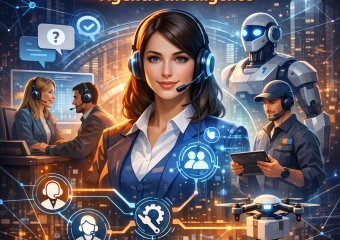


Unifying AI Support: Streamline Chat, Voice & Email Effortlessly
Unifying Support Channels with AI: The Evolution from Email to Chat to Voice
From Email to Chat to Voice: This trajectory in customer support channels not only signifies technological advancements but also reflects a shift in consumer expectations. As communication technologies have evolved, so has the approach businesses take to manage customer interactions. Artificial Intelligence (AI) now stands at the forefront of this revolution, seamlessly integrating these varied channels into a cohesive support system that offers both efficiency and accessibility.
The Early Days: Email as a Support Staple
Initially, email was the frontrunner in support channels, prized for its documentation capabilities and non-intrusiveness. Businesses relied heavily on email to handle customer inquiries, complaints, and other communications. However, while email allowed for detailed records and was excellent for non-urgent queries, it lacked immediacy. As customer expectations veered towards faster responses, the need for more instantaneous channels became evident.
The Rise of Instant Messaging
As internet speeds increased and technologies advanced, chat systems began to emerge as a preferred medium for customer support. Unlike email, chat could offer real-time interactions, making it possible for customers to have their issues resolved quickly without the delays inherent in email correspondence. Furthermore, chat systems began to incorporate AI through chatbots, enhancing the ability to provide instant responses even when human agents were not available.
Enter Voice Interfaces
Voice technology is perhaps the most natural form of communication for humans. With the rise of AI-driven voice assistants like Amazon’s Alexa, Google Assistant, and Apple’s Siri, voice interfaces are being increasingly adopted for customer support. These systems can handle inquiries and solve customer issues through spoken dialogue, making the experience even more intuitive and interactive. Voice support, enhanced by AI, can understand, process, and respond to customer needs with impressive accuracy.
Integrating AI Across All Channels
This integration is not just about having AI; it’s about creating a seamless customer experience across all touchpoints. AI excels in analyzing vast amounts of data, learning from interactions, and making informed decisions, which helps in unifying these various channels. For instance, AI can suggest solutions based on previous interactions, regardless of the channel. Whether a customer starts a conversation through email, switches to chat, and then moves on to voice, AI can maintain the continuity and context throughout this journey.
Transforming Customer Interactions with AI
-
Consistency Across Channels: AI can ensure that the tone and solutions offered are consistent across all platforms. This consistency builds trust and enhances customer satisfaction.
-
Predictive Support: By analyzing past behavior and common inquiries, AI can predict questions and offer proactive solutions, often before the customer initiates contact.
-
24/7 Availability: Unlike human agents, AI-driven support systems can operate around the clock, providing answers and support when customers need it, regardless of time zone or holiday schedules.
-
Personalization: AI algorithms can analyze individual customer data and tailor interactions to meet personal preferences or past behavior, leading to highly personalized customer service experiences.
Challenges in AI-Driven Unified Support
While the benefits are numerous, the challenges in implementing AI across various support channels are significant. Integrating AI requires substantial investment in technology and training. There is also the ongoing challenge of keeping AI systems updated with the latest information and ensuring they are sensitive to the nuances of human communication.
Looking to the Future
The future of customer support is inevitably linked to the advancement of AI technologies. As we move forward, AI is set to become even more sophisticated, with capabilities likely to include advanced emotional recognition, deeper personalization, and even more seamless integration across diverse communication platforms.
In conclusion, the evolution from email to chat to voice in customer support channels reflects broader technological trends and changing consumer expectations. AI is the linchpin in this evolving landscape, promising to transform how businesses interact with their customers by making communications more intuitive, responsive, and personalized. As businesses continue to implement and refine AI technologies, the potential to enhance customer service and satisfaction seems boundless.